
the foundations of arousal
Rosemary Basson, a physician and sex researcher at the University of British Columbia, proposed her model in 2000 as a challenge to the linear sequences that had dominated sexology. Prior to this model, Masters and Johnson had described sexual response as a progression from excitement through plateau and orgasm to resolution, and Helen Singer Kaplan later added desire as the first step. In both versions, spontaneous desire is the starting point that sets everything else in motion. Basson argued this didn’t match the experience of many women, particularly those in long-term relationships, who often reported rarely feeling desire “out of the blue” yet still had satisfying sex lives. Rather than treating this as dysfunction, she proposed that it reflected a different but entirely normal pathway into sexual experience.

Her model is circular rather than linear. It often begins from a state of sexual neutrality, with motivation coming from non-sexual reasons: wanting emotional closeness, to express affection, to feel connected to a partner, or simply to share an experience. That willingness makes a person receptive to sexual stimuli, and if the context is right, and the brakes discussed earlier aren’t pressed too hard, those stimuli produce subjective arousal. Desire then emerges in response to arousal rather than preceding it. Basson called this responsive desire, distinguishing it from spontaneous desire, which she saw as one possible entry point among several. The cycle closes with emotional and physical satisfaction, which deepens intimacy and increases the motivation to engage again. Crucially, the model treats satisfaction as broader than orgasm, and treats the person’s mental and relational context as central rather than peripheral.
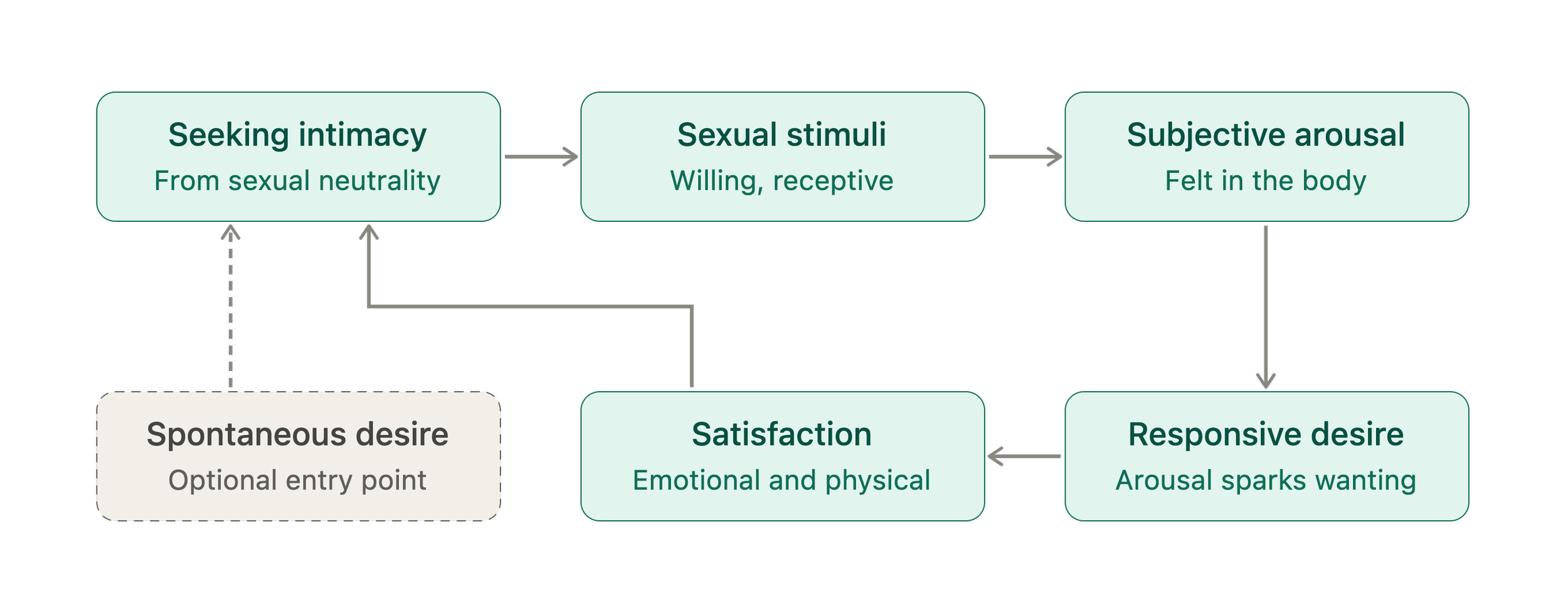
Basson’s work has been influential clinically and diagnostically. It helped reframe low spontaneous desire as something that isn’t automatically a disorder, and it informed the DSM-5’s 2013 decision to merge female desire and arousal problems into a single diagnosis, Female Sexual Interest/Arousal Disorder. It also underpins much of the popular advice telling people they don’t have to wait to “feel like it.” The model has drawn critiques, though. Studies testing it have found that women endorse linear and circular models in varying proportions, with the circular model sometimes more common among women reporting sexual difficulties, which complicates the claim that it simply describes normal functioning. Researchers have also questioned framing it as a specifically female model, since many men report responsive desire too, and the distinction between spontaneous and responsive desire is now often treated as a spectrum that applies across genders.
